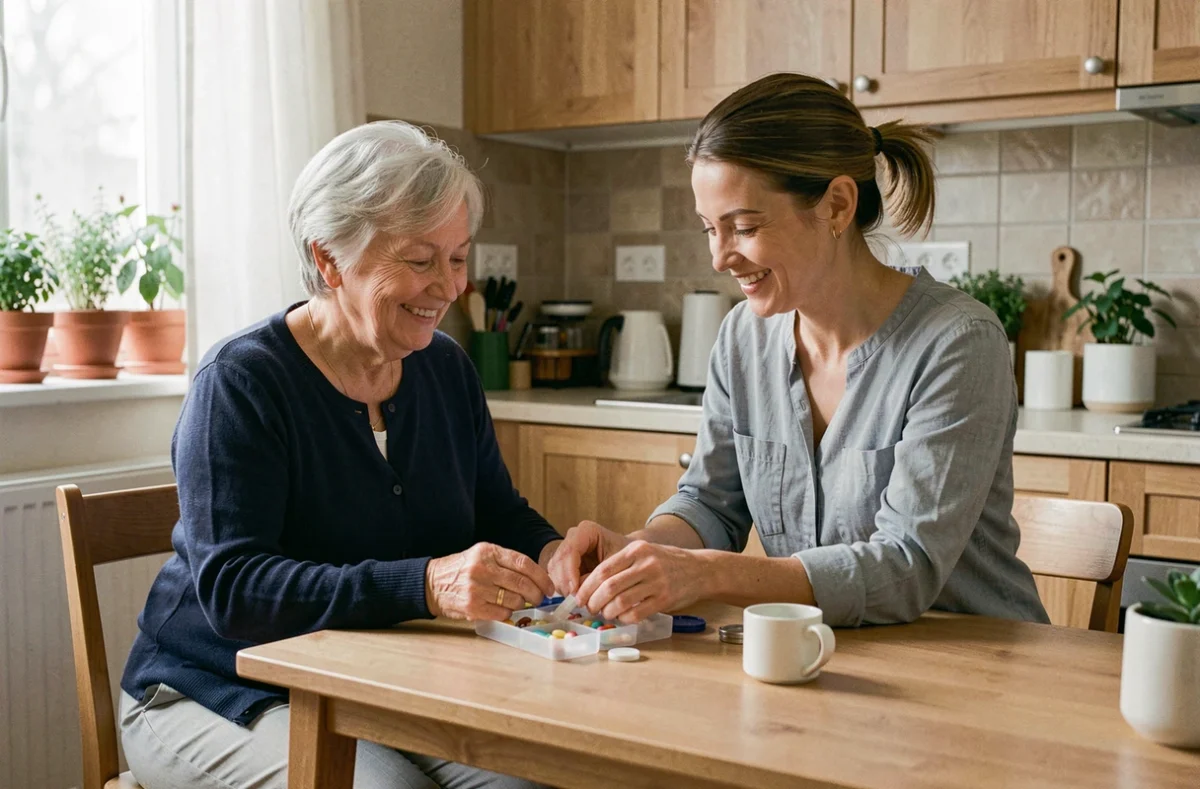
The home care for elderly people relies on a set of services that cover assistance with daily tasks, paramedical care, and adaptation of the living environment. Since 2023, a structural reform has reorganized these services around a new framework: the home autonomy services (SAD), which gradually merge the former SAAD, SSIAD, and SPASAD to prevent breaks between assistance and nursing care.
Home autonomy services: what the SAD merger changes
Before this reform, an elderly person experiencing a loss of autonomy often had to coordinate two distinct structures: a service for household tasks and meals, and a nursing service for medical acts. This separation generated administrative duplications and interruptions in care, especially after hospitalization.
The SAD brings these two aspects together under a single entity. The goal is for a single contact person to organize both daily support (bathing, dressing, shopping, housing maintenance) and paramedical care (dressing changes, injections, treatment monitoring). For families, this simplifies the processes: one file, one schedule, one billing.
This consolidation also allows for earlier detection of health deterioration. The caregiver who visits every morning can report a change in behavior or loss of appetite directly to the coordinating nurse, without first going through the primary care physician. When looking to identify the services on Happy Seniors, this coordination logic is clearly reflected in the listed offers.

MaPrimeAdapt’ and housing adaptation: deadlines to anticipate
Adapting a home remains one of the most effective levers to prolong autonomy. A support bar in the bathroom, a stairlift, or replacing a bathtub with a walk-in shower significantly reduce the risk of falling, the leading cause of hospitalization for those over 65.
MaPrimeAdapt’ finances part of these works. The scheme, managed by Anah, covers housing adaptation for seniors experiencing a loss of autonomy under certain income conditions. In practice, the 2025 report from Anah indicates sustained activity but also management tensions. The backlog of pending files is being resolved, and the delays can reach several months depending on the regions.
Two precautions are necessary to avoid unpleasant surprises:
- Submit the file before the loss of autonomy becomes critical, as work cannot begin until funding approval is obtained, risking the loss of the grant.
- Have a diagnosis carried out by an occupational therapist or housing advisor before choosing equipment, to target truly useful adaptations rather than standardized solutions.
- Check if the municipality or department offers complementary assistance, as MaPrimeAdapt’ does not always cover the entire remaining cost.
Respite pathways for family caregivers
Support for family caregivers has long been the neglected aspect of autonomy policies. A relative caring for a senior with Alzheimer’s disease or a disabling condition often provides several hours of help per day, without training or relief.
A national experiment is paving the way for a coordinated respite pathway. This scheme combines several complementary solutions: day care, temporary accommodation, respite platforms, and home relief. Decree No. 2025-827 of August 19, 2025, regulates the home replacement services for the family caregiver, providing a legal framework for the temporary replacement of the caregiver by a professional.
Home relief deserves special attention. A professional intervenes at the senior’s home while the caregiver is absent, whether for a few hours or several days. The senior remains in their usual environment, which limits the disorientation often experienced during a change of location, especially in cases of cognitive disorders.
Identifying the right time to seek respite
Caregivers often wait until they are completely exhausted before asking for help. The warning signs to watch for are concrete: persistent sleep disturbances, unusual irritability towards the cared-for relative, abandonment of personal activities, or postponed medical consultations due to lack of time.
Respite platforms, available in most departments, offer a free interview to assess the situation and direct towards the appropriate solution.
Coordination of financial aids: APA, pension funds, and complementary aids
Funding for home care relies on several sources that do not mutually exclude each other. The Personalized Autonomy Allowance (APA) serves as the foundation for individuals classified in GIR 1 to 4. It finances a personalized care plan that may include hours of home help, meal delivery, or teleassistance.
Pension funds (Agirc-Arrco for the complementary scheme) offer services for retirees who are still autonomous (GIR 5 and 6), including post-hospitalization support that temporarily covers home help and meal delivery during recovery.
A common mistake is to only seek one funder. An elderly person in GIR 4 can combine the departmental APA with a one-time aid from their pension fund for housing adaptation, and partial coverage of teleassistance by their mutual insurance. Crossing these schemes significantly reduces the monthly out-of-pocket expenses.
Administrative complexity remains the main barrier. CLICs (local information and coordination centers) and local information points can assist families in assembling the files. Going through these offices avoids discovering assistance six months after being entitled to it.
Home care is not limited to an isolated service. It is the articulation between housing adaptation, coordination of providers, and support from the surrounding community that determines its long-term viability. The SAD, by unifying assistance and care, establishes a clearer framework, but the financial setup remains the responsibility of families, who have every interest in seeking support as soon as the first signs of loss of autonomy appear.